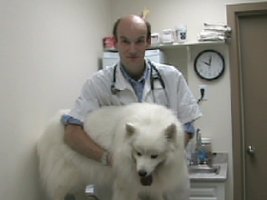
Choosing The Right Veterinarian
Choosing the right veterinarian for your American Eskimo dog
is one of the most important decisions you will make about
the health of your dog. Without a doubt, at some point
your Eskie will fall ill on a Sunday evening when most
veterinarian offices are closed. If this happens, you
will have no choice but to go to an emergency clinic. This
will be very costly and the emergency clinic will not have
your pet's health file on record. So it's important to
establish a relationship with a veterinarian at a clinic
that is open 7 days a week and where you can call 24/7 for
help in case of an emergency. Try to pick such a
clinic that is closest to home so when your Eskie's health
is in distress, you do not have very far to drive.
What To Do In Case Of Emergency
It's Sunday evening and your American
Eskimo has just swallowed a plastic ball. Your Eskie has started bleeding.
What to do? When you
have a health emergency on your hands and you can't get to
your vet right away, it's good to know there's an Emergency Clinic you can always take your Eskie
without needing a referral from your veterinarian. For critical care any time, day or
night, 7 days a week, you can take your Eskie to the Vancouver Animal Emergency Clinic located at the corner of
4th and Fir, just to the north of Granville Island.
VAEC has an excellent staff, advanced diagnostics, surgery and treatment facilities. You can
call 604-734-5104 to speak with a tech or a vet at the Clinic.
There is also Canada West - Critical Care Group just off 2nd and Boundary. This is the
largest critical care hospital in the Lower Mainland. However, you need a referral from your veterinarian
before being able to take your Eskie to Canada West.
If you live outside of the Vancouver
area, it's a good idea to talk to your vet in advance about
what to do in case of an emergency. Identify an
Emergency Clinic closest to where you live so you'll know
where to take your American Eskimo in case of an
emergency.
Vaccinations
Vaccinations are important to ward off illnesses that can be
fatal for your American Eskimo. Routine vaccinations include
distemper, parvovirus and rabies. You may wish to consult
with your veterinarian on additional vaccines available
including bordetella, often referred to as kennel cough,
leptospirosis which can be picked up by drinking standing
water, lyme disease contracted through ticks, giardia,
sometimes called beaver fever picked up by drinking stream
or river water and heart worm which can be contracted
through hiking in areas such as the Okanagan. Factors such as
where you live and where you take your Eskie, will help you
and your veterinarian to decide which vaccinations are
appropriate for your dog.
Bloodwork
Whenever humans go to their doctor for their annual checkup, invariably that involves
going for blood tests. Although veterinarians rarely suggest a blood test for your dog,
unless they are suspicious of illness, you may want to ask your veterinarian for a
general panel blood test at the time of the yearly checkup. Having blood tested on your Eskie
may help to detect the
early onset of diseases before the diseases display physical symptoms. It gives
you an opportunity to adjust a diet or maintenance or your dog's health to help prevent the
onset of diseases. The general panel blood test typically
ranges in price between $50 and $100 depending on your veterinarian.
Vomitting
Vomitting is not natural for any dog. Sometimes you may see your Eskie vomit once perhaps if he picked
up something off the grass. If your Eskie vomits more than once or twice in a row, it is time to pack him up and take him to
the vet immediately. Dehydration from vomitting happens quickly. This can lead to other health problems. Repeated vomitting
is a serious sign of something gone wrong. It is a reaction to something. It could be a food allergy or it could be due to
toxic exposure to something. It could also be a sign of some other potentially life threatening health
problem. In either case, you need to take your Eskie to the hospital right away.
Worming
Eskies of all ages, especially young puppies are
susceptible to getting worms, even under the best of circumstances
when they've been kept in clean crates and so on. Many worms
are not actually visible, so just because you can't seem
them, doesn't mean they are not there. You can collect a stool
sample in a clean plastic bag and take it to the vet. They usually charge
somewhere around $10 to $20 to examine the stool
sample and can tell you reasonably quickly whether your
puppy has worms or not.
If your puppy or adult Eskie has worms, it is easily
treatable with a cheap prescription. There is no need to administer a monthly de-worming pill. There
is a lot of literature that says that over the long term, monthly de-wormings can be toxic and lead to
cancer. So, to be safe, only get your dog de-wormed when he
or she actually has worms. A typical symptom of
worms is if your dog has diarrhea for more than a day or two. Use prescriptions for worming from the vet -
not the stuff you find at Safeway.
Diarrhea
Diarrhea is a symptom of many different
things, from an inappropriate diet to serious illnesses.
For example, if you change your Eskie's food, he may have a
soft stool until his digestive system gets used to the new
food. Or your Eskie can have a food allergy. Often diarrhea is a symptom of catching a bug
from sniffing other dogs or having licked contaminated water
or grass. No matter how careful you are with your
Eskie, know that they can pick up bugs easily.
You can tell if it is some type of bug because the diarrhea
will persist either in the form of several eruptions
throughout a short time period, like Montezuma's revenge
over several hours to several
days. If you suspect it is a bug, a quick trip to the
vet is in order for a course of anti-biotics such as Flagyll
and a paste called Diarsanyl which is a nutritional
supplement used to calm the intestinal tract and help settle
the diarrhea.
Diarrhea is also a symptom of Beaver Fever or Giardia which
can also be passed on to you from your Eskie. Your
Eskie does not actually have to have a fever to have Giardia.
If you
want to rule out Giardia, take a stool sample from your
Eskie to the vet for testing.
If you see blood in your Eskie's stool, take your Eskie to
the vet right away. Blood in the stool looks like dark brown tar. It should look distinctive from the rest of the stool.
If you see blood coming from the
poop hole, this is Hemmorrhagic Gastroenteritis which is
very serious and life threatening. It is an indication of internal bleeding somewhere. Take your Eskie to a vet right
away. Even if it is in the middle of the night, go to
emergency right away.
The 2 most important things to know about diarrhea is that
your Eskie may get dehydrated very quickly and this can lead
to other serious health issues such as kidney failure. So be sure to keep a
bowl of water with ice handy and make him or her drink water
more frequently than they normally do. Lethargy and
tiredness is a sign of dehydration. If your Eskie is
lethargic and not interested in drinking water, hold an ice
cube in your hand and put it up to his nose to lick. If this
doesn't work, then squirt water into his or her mouth with a plastic
syringe.
The second most important thing is to stop feeding food to your Eskie until
the diarrhea has subsided somewhat. This could be for
6 to 12 to 24 hours after the last bout of diarrhea, depending on how severely ill they are.
They most likely will not want to eat while they are feeling
lousy. They will let you know when they are
hungry. Start them back on a very bland diet such as
the Gastro canned formula made by Medi-Cal available at your
local vet's. Or you can boil some rice and add some plain chicken to the rice.
Diarrhea can be a symptom of Gastroenteritis and your vet
will be able to make this diagnosis and prescribe treatment.
Diarrhea can also be a symptom of Irritable Bowel Disease or
IBD. If you find your Eskie almost always has a soft
stool or has diarrhea frequently without other symptoms or
health issues, it
could be that they have a delicate intestinal tract.
In this case, feed them a bland diet or hypo-allergenic diet
such as the Gastro or Hypo Allergenic dry and canned dog
food made by Medi-Cal available at your local vet's office.
If you find your Eskie's stool is always fairly soft and
health issues have been ruled out, try adding a half teaspoon of fibre to the morning meal.
The fibre recommended to us by vets and veterinary specialists is Metamucil, original course grade fibre powder. It is 100% natural sourced physillium fibre. It comes with real sugar mixed
in. Be careful NOT to buy the blend that contains artifical sugars as ARTIFICAL SUGARS ARE DEADLY FOR DOGS. Metamucil is available at Shoppers Drug Mart. If
you find your Eskie does not want to eat his food after it has been sprinkled with Metamucil, you can mix the Metamucil in with a large tablespoon of yogurt or non-fat
sour cream. Be sure to feed the fibre with a meal, within 15 minutes after having eaten a meal, preferably the first meal of the day.
The thing to know about diarrhea is that if it persists, you
should take your Eskie to the vet to have it checked out and
make sure that it is not a symptom of a serious illness or
disease.
Constipation
Most Eskies on average defecate at least once a day. Once in a while, they may skip a day, especially if they have not eaten. However, constipation is
not normal. If food is going in and not coming out, this is an indication of some underlying health issue. Worst case scenario, it could be an indication of blockage in the intestines or a
twisting of the intestines. With a blockage or twisting, you might notice some distention or bloating of the stomach area and it may feel hard to the touch. Your Eskie may be laying on his side
and not wanting to move much because a blockage or twisting of the intestines is painful. Chewing and swallowing bone splinters, parts of plastic toys,
treats made from Nylabone, rawhide or pressed bone or Greenies can all cause intestinal blockage. If you suspect an intestinal
blockage, get it looked at right away as this is life threatening. Relief for pain due to
intestinal twisting includes walking your Eskie for long periods and not letting them lay down much.
Other causes of constipation can be related to the gall bladder or liver. If your Eskie has constipation on a recurring or regular basis, get it checked out by a vet. A sluggish gall bladder
can cause the gall bladder to swell and rupture. A rupture is fatal.
Be sure to keep track of your Eskie's bowel movements. If your Eskie is eating but has not defecated after 2 days, feed them at least one cup of canned pureed pumpkin. This
should cause a bowl movement to occur within 24 hours. If your Eskie does not have a bowel movement after 4 days, be sure to go to the vet as you most likely have an emergency on your hands.
Dehydration
Dehydration results from lack of water
and often results from repeated vomitting and/or
diarrhea. Dehydration can lead to serious illness so
it is very important to watch for. Lethargy and lack
of energy can be signs of dehydration.
IT IS VERY IMPORTANT TO ALWAYS KEEP A BOWL OF FRESH WATER
AVAILABLE TO YOUR ESKIE TO DRINK 24/7, no matter their
age. Be sure to change the water at least 3
times a day, first thing in the morning, in the afternoon
before dinner time and in the evening for overnight.
Use a stainless steel bowl for the water rather than a
plastic bowl. Wash the bowl with gentle dishwashing
liquid and not harsh cleaning chemicals.
All dogs do no sweat. The only mechanism that they
have to cool down is panting. So never leave your
Eskie in the car when it is warm outside. They can get
dehydrated very easily very quickly. Ten minutes left
in the car in the heat of the summer can be enough to kill
your Eskie. If you see them panting in the car, don't
leave them in the car. Cracking the window does not
count when they are panting.
Racoon Virus Is Fatal
Not well known to most dog and cat owners
is the fact there is a virus contained in racoon scat that
is fatal to dogs and cats.All they need to do is sniff the
racoon poop and it will be fatal. So if you have an
area around your home where racoons frequent, do what you
can to keep the racoons away and never let your cat or dog
into that area. Nothing can be done for them medically
to save their lives once they contract that racoon
virus.
Flea Powder Can Be Fatal
We have had reports of Eskies dying of
toxicity once exposed to flea powder. They become
thirsty and lethargic as their kidneys shut down and they
can die in a matter of a few days. So, don't take the
chance of administering flea powder to your cat or
dog. Make sure you give these clear instructions to
any groomer or person that will be taking care of your Eskie in
your absence.
If your Eskie gets fleas, you can get a prescription for
pills from the vet that will kill the fleas in a few
days. You can also administer drops by prescription
from your vet to prevent fleas from re-infesting your Eskie.
If you live in an area where there are no fleas and your
Eskie is not at risk for getting fleas, then there is no
need to administer monthly drops to prevent flea
infestation.
PRA Sited As "common" In Eskies
PRA is an eye disease that has been sited as "common" in Eskies. It is a
disease that can sometimes lead to blindness. If you see a change in the way your Eskies eyes look or notice any
changes in their vision, be sure to visit the West Coast Veterinary Eye Specialists in New Westminster.
There are two top notch veterinary opthalmology specialists on staff with diagnostic
and surgical facilities. This is the only specialty eye clinic for animals in the province.
West Coast Veterinary Eye Specialists
460 East Columbia Street
New Westminster, BC V3L 3X5
http://www.westcoastanimaleyes.com
info@westcoastanimaleyes.com
phone: 604-777-4448
There is a genetic test called The OptiGen prcd-PRA Test
that is performed by OptiGen Labs in New York. For information about the test, please visit
http://www.optigen.com/opt9_test_prcd_pra.html
There are lists of Eskie breeders on the web who have had the OPTIGEN Pattern A test
done on their Eskies. You can avoid buying an Eskie with PRA by ensuring it comes from a breeder
who has had the dame and sire of the puppy OPTIGEN certified. Here are the lists:
http://myweb.cableone.net/lenise/optigen.htm
Tear Stains
Tear stains will appear in some Eskies eyes and not in others. It depends on the structure of the
eye and whether or not there is any leakage from the eye. The staining is caused by a natural element in the eye fluid.
It is typically rust coloured. According to veterinary opthalmologists, this a natural occurence and not much can
be done to eliminate the staining. No chemicals should be applied in or around the eye area. For best management,
gently wipe under your Eskies eyes in the morning with a wettened cottonball. Be sure not to touch the eye
surface or inside the eyelids.
Eye Goop
From time to time you may see some mucus appear on the surface of the eyeball. It is generally
semi-transparent and colorless. When you see this, you should wash your Eskies' eyes right away. Otherwise, not only
may it occlude his vision, but it can scratch the inside lid or the eyeball which may cause vision problems. To
clean your Eskies' eyes, you'll need some water at room
temperature, an eye dropper and some soft Kleenex
tissue. To apply, place your hand under your Eskies' chin, tilt his
head back and squirt the water from the dropper into the affected eye. Then wipe the excess off from around his eye with
Kleenex. Be sure not to touch the eyeball with the
dropper or the Kleenex. Repeat this until you see the mucus has disappeared
from the eye. Never touch the eyeball.
Don't Shave Your Eskie
Don't shave your Eskie. All Eskies have very fair skin that is not meant to be exposed to the sun.
Sun burn and skin problems can occur. Often after exposure to
the sun, the pigmentation in the skin will change and areas
that were previously pink skinned will turn black,
just like an Eskies nose. An Eskie has a double coat of hair. An inner thick coat that protects the skin
and a longer outer coat that crowns the body. An Eskie's hair acts as a temperature regulator. It keeps
him both warm in the winter and cool in the summer. Dogs do not have sweat glands. They cool off by panting. You can
thin out the inner coat, clip the outer coat, but never shave your Eskie for health reasons.
Some Eskies get follicle arrest - that is, their hair does not
grow back in the area that has been shaved.
|